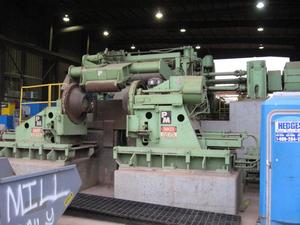
Warranty:12 months.,12 months start from the date finishing installation.
After-sales Service Provided:Engineers available to service machinery overseas
Product Name:Annual Output 150000T Clinker Cement Production Line
Capacity:annual output 150000T
Production Method:dry type
Calcination method:horizontal rotary kiln
Cement type:silicate cement
Certificate:ISO9001:2000, CQC,BV.
Spare parts:available at favorable price.
Pre-sale service:plant design.
Installation:technician support provided.
Packaging & Delivery
Packaging Details:
Nude packing, spare parts in wooden case.
Delivery Detail:
15-25 days after receipt deposit.
Specifications
Annual Output 150000T Clinker Cement Production Line professional cement production equipments manufacturer. energy saving.
Annual Output 150000T Clinker Cement Production Line
1. crushing and prehomogenization
In the course of cement production, most of the raw materials will be crushed, such as limestone, clay, iron ore and coal etc. The limestone is greatest in consumption of all the raw materials when producing the cement, has the bigger size and higher hardness after the exploitation.
2. Raw Material Preparation
In process of producing the cement, the production of 1 ton Portland cement needs grinding at least 3 tons of materials (including all kinds of raw materials, fuel, clinker, mixture, plaster). According to the statistics, the required power consumption for grinding dry cement accounts for more than 60% that of the whole plant, in which more than 30% for raw material grinding, about 3% for coal grinding, about 40% for cement grinding.
3. homogenization
In the production process of new dry cement, the stability of raw material component entering the cellar is premise of stabilizing the clinker sintering thermal system. The homogenization system plays the last line of control function in stabilizing the raw material components entering the cellar.
4. Preheating and decomposition
The preheating and decomposition of raw materials are accomplished by the preheater, instead of rotary kiln, shortening the kiln length, and make the heat exchange process of materials in the state of accumulation in the kiln.
Processed in the preheater in a state of suspension, the raw materials can be fully mixed with the hot gases discharged from the kiln, increasing the contact area for gas materials, as a result, fast heat transfer speed and high heat exchange efficiency, increasing the productive efficiency of kiln system, and decreasing the heat consumption of clinker sintering.
5. sintering of cement clinker
After the raw material completes preheating and precalcining in the cyclone preheater, it begins the sintering of the clinker within the rotary kiln for the next procedure.
In rotary kiln the carbonate is for further quick decomposition and makes a series of solid-phase reaction, generating the cement clinker mineral. With the rising of the materials temperature, these minerals will become into the liquid phase, and make reactions and produce large numbers of the clinkers.
After the clinker sintering, the temperature goes down. finally the high temperature clinker unloaded from the rotary kiln is cooled by the cooling machine to the temperature which can be borne by the downstream conveying, storage and cement mill, recycle the sensible heat of the high temperature clinker at the same time, and improve the heat efficiency of the system and quality of the clinker.
6. Cement grinding
The cement grinding is the last process, and also the most power consumption of the process. Its main function is to grind the cement clinker (gelling agent, performance adjusting material, etc) to the suitable size (indicated by the degree of fineness, specific surface area), form a certain grain composition, increase its hydration area, accelerate the hydration speed, and meet the needs of the cement slurry condensation and hardening.
7. cement packing
The Cement has two kinds of shipping methods of bag and bulk packing on delivery.
Similar Products
Condition : NEW
Model#: Annual Output 50000T
Location:
China
Condition : NEW
Model#: annual output 300000T
Location:
China
Condition : NEW
Model#: 30000-300000 CBM AAC production line
Location:
China
Condition : NEW
Model#: 150 t/d
Location:
China
Condition : NEW
Model#: 50T/H
Location:
China
Condition : NEW
Model#: 20T/H
Location:
China
Condition : USED
Model#: M LINE
Location:
United States
Condition : USED
Location:
United States
Condition : USED
Location:
United States
Condition : USED
Model#: TSS9
Location:
United States
Condition : NEW
Model#: Pneumatic Cement Spec Tank
Location:
United States
Condition : USED
Model#: SERVO LINE
Location:
United States
Condition : USED
Model#: Steel Line
Location:
United States
Condition : USED
Model#: SERVO LINE
Location:
United States
Condition : USED
Model#: BQ-470D Line
Location:
United Kingdom
Condition : USED
Model#: SERAMILL 240
Location:
United States